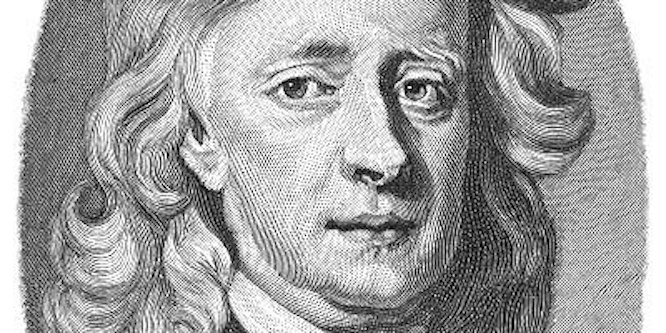
About
Sir Isaac Newton, a towering figure in the history of science and mathematics, was a physicist and mathematician who fundamentally changed our understanding of the universe. Born in Woolsthorpe, England, he is celebrated as one of the most influential scientists of all time. Newton's groundbreaking work laid the foundation for classical mechanics and made significant contributions to optics, calculus, and theology. His laws of motion and universal gravitation are cornerstones of modern physics, shaping our understanding of how objects move and interact.
Before Fame
Newton's early life was marked by challenges. Born prematurely after his father's death, his mother initially intended for him to become a farmer. However, recognizing his intellectual potential, Henry Stokes, the headmaster of King's School, persuaded Newton's mother to allow him to pursue his education. This pivotal moment set the stage for Newton's remarkable academic journey.
Career Highlights
Newton's career is defined by a series of monumental achievements. He formulated the three basic laws of motion, which describe how objects move in response to forces. His law of universal gravitation explained the force that attracts objects to one another, including the Earth's gravitational pull. Newton also made significant advancements in optics, demonstrating that white light is composed of a spectrum of colors. He developed the first practical reflecting telescope, a revolutionary invention that improved astronomical observation. Furthermore, his work on infinitesimal calculus, independently developed alongside Gottfried Leibniz, provided a powerful tool for solving complex mathematical problems. Newton's magnum opus, Principia Mathematica, became the basis of modern mathematics and physics, solidifying his legacy as a scientific genius.
Trivia
- He and Gottfried Leibniz independently invented infinitesimal calculus.
- His book, Principia Mathematica, became the basis of modern mathematics.
- Albert Einstein had a picture of Newton on his study wall, a testament to Newton's enduring influence on physics.
- His work helped Enlightenment thinkers rebel against Church theology, impacting intellectual and philosophical thought.
Family Life
Isaac Newton was born three months after the death of his father, also named Isaac, who was a farmer. He grew up with two stepsisters, Mary and Hannah, and a stepbrother named Benjamin. Newton never married and had no children. His dedication to his scientific pursuits consumed much of his life.